Loop Recorder Follow-Up: Closing the Scheduling Gap in Ambulatory EP
Loop recorder patients present a unique scheduling challenge. Their monitoring window often extends 2–3 years, and follow-up gaps compound clinical risk
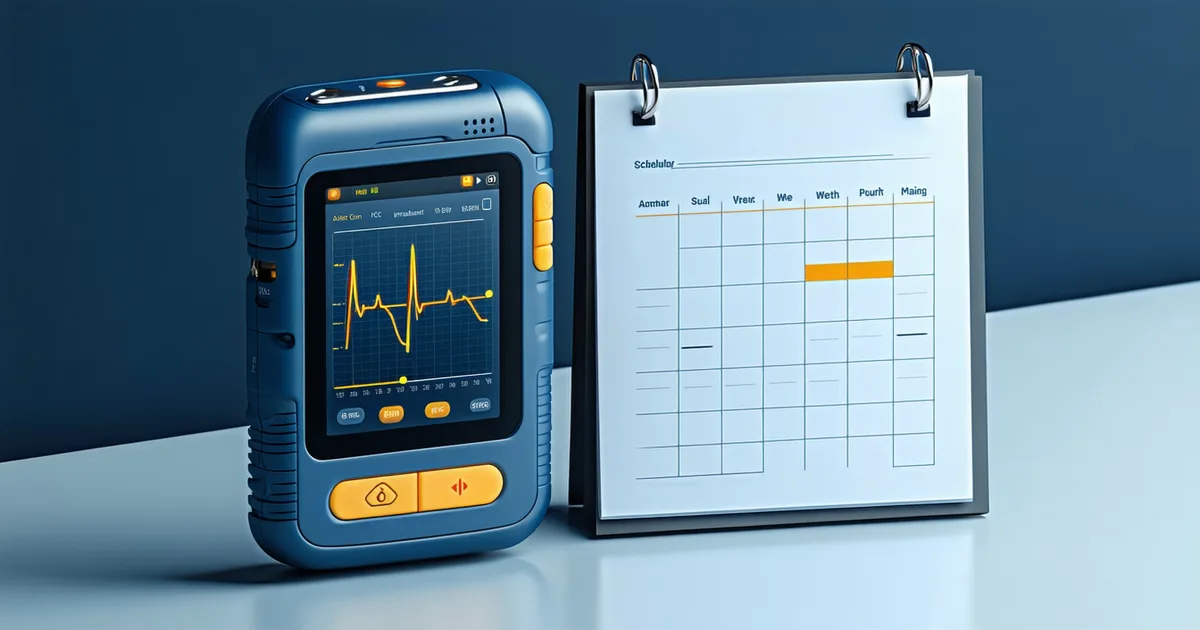
The implantable loop recorder (ILR) presents a scheduling problem that most device clinic workflows were not built to handle. Unlike a pacemaker or ICD patient, whose post-implant follow-up schedule follows a relatively predictable cadence driven by device check intervals and CMS billing windows, the ILR patient enters a monitoring horizon of two to three years — sometimes longer — during which clinically significant findings may occur on any given day or not occur at all for months.
The clinical indication drives this variability. A patient implanted with an Abbott Confirm Rx or Boston Scientific Lux-Dx for unexplained syncope needs clinical contact if the device detects a relevant pause or high-rate episode; absent that, routine check-ins may be relatively infrequent. A patient implanted after a cryptogenic stroke for AF detection needs timely review of any AF episode that crosses the threshold relevant to anticoagulation decision-making — and may need rapid clinical escalation if sustained AF is documented. Neither patient fits neatly into the quarterly/semi-annual rhythm that structures ICD and pacemaker follow-up.
How ILR patients fall out of the scheduling queue
A 3-physician EP practice in the southeastern US that manages approximately 280 active ILR patients alongside its ICD and pacemaker panel described the scheduling gap clearly. "Our ILR patients aren't scheduled in the same system as our other device patients," the device clinic coordinator explained. "They're kind of floating. We rely on the monitoring service alerts to tell us when something happens, and then we call. But if nothing triggers an alert for six months, we might not have actively looked at that patient's record in six months."
This is the structural problem. ILR follow-up in current clinical practice is largely reactive — the clinic responds when a device-generated alert fires. The interval between alerts can be long, and during that interval a patient may have had low-rate episodes below the alert threshold, device battery consumption that warrants checking, or a change in clinical status (new diagnosis, medication change affecting arrhythmia substrate) that should prompt a proactive review.
The HRS Expert Consensus on remote monitoring guidance supports scheduled remote follow-up for ILRs, not just alert-triggered contact. The CMS billing framework for ILR remote monitoring (CPT 93298 — remote monitoring of physiologic parameter(s), including analysis, interpretation, and report) supports a 30-day billing period, meaning monthly contact with ILR patients is both clinically supported and reimbursable. The practical execution — actually scheduling that monthly contact, tracking which ILR patients have been reviewed in the current period, and surfacing the ones who haven't — is where clinics consistently fail at scale.
The compounding risk of follow-up gaps
For the syncope indication, a follow-up gap means a potentially delayed diagnosis. The clinical utility of the ILR in cryptogenic syncope is contingent on prompt clinical action when a significant arrhythmia is detected. A bradycardic pause documented on a Monday transmission that isn't reviewed until Friday of the following week represents a week of uncertainty about whether the patient is at risk for recurrent syncope with injury. In a patient who is still driving, that delay has concrete implications.
For the post-stroke AF detection indication, the stakes are higher. A sustained AF episode detected by the ILR may be the evidence that triggers anticoagulation initiation — a decision with meaningful impact on secondary stroke risk. The time from episode detection to clinical review to treatment decision is a clinical quality metric, not just an operational preference. Programs that allow ILR transmissions to sit unreviewed for days are likely missing the window during which timely treatment decisions have their greatest impact.
We're not suggesting that all delayed ILR reviews result in adverse outcomes — many ILR alerts will be false positives or low-acuity findings. But the structural practice of treating ILR follow-up as optional or purely reactive rather than scheduled and tracked creates a systematic gap whose cumulative effect on patient care quality is real, even if any individual delayed review is not high-risk in isolation.
Urgency-weighted scheduling: what it looks like in practice
The core concept in urgency-weighted ILR scheduling is that not all ILR patients have the same follow-up urgency at any given time, and the scheduling queue should reflect this dynamically rather than treating all ILR patients as equivalent. Several factors can affect an ILR patient's scheduling urgency:
Recent alert events: An ILR patient who has had a detected AF episode in the past 7 days has elevated scheduling urgency regardless of whether the alert was already acknowledged. The clinical team may have reviewed the alert, but has the clinical action (anticoagulation decision, cardiology appointment, referral) been completed and documented? If not, the patient needs active follow-up, not just monitoring.
Time since last clinical review: An ILR patient whose record has not been actively reviewed in 45 days — regardless of whether alerts have fired — should surface in the follow-up queue. The absence of an alert doesn't mean everything is fine; it may mean nothing has crossed the threshold, which is useful information that should be acknowledged in a periodic review interaction.
Indication-specific time sensitivity: A post-stroke patient being monitored for AF has inherently higher follow-up urgency than a patient implanted for pre-ablation AF burden assessment. The scheduling logic should reflect indication when prioritizing outreach.
Battery status: ILR batteries typically last 3 to 4 years depending on device type and transmission frequency. A patient approaching the device longevity window needs scheduling for explant planning — a follow-up gap that extends past device ERI means losing monitoring continuity at the point when a replacement decision needs to be made.
The relationship between ILR scheduling and the broader device panel
One structural challenge unique to ILR scheduling is that ILR patients are often managed by a different clinical team or with a different workflow than the ICD/pacemaker panel. In some programs, ILRs are primarily ordered by general cardiology or neurology (for post-stroke workup) rather than by the EP service. The follow-up responsibility may be shared or unclear. This creates an organizational gap that no scheduling tool can fully solve — it requires explicit clinical ownership assignment.
The more tractable problem is the scheduling tool layer. A follow-up scheduling queue built for device clinics needs to handle ILR patients as a distinct scheduling category — not slotted into the ICD/pacemaker follow-up rhythm, but also not left to float untracked between alert events. Monthly review intervals, urgency weighting by recent alert status and indication, and explicit tracking of whether the review interaction has resulted in a documented clinical action are the minimum requirements.
Coordinating ILR follow-up with billing documentation
The CPT 93298 billing cycle for ILR remote monitoring supports monthly claims within a 30-day service period. The claim requires documentation of remote data collection and physician analysis and interpretation. Clinics that manage ILR patients reactively — waiting for alerts rather than scheduling proactive reviews — tend to have inconsistent billing documentation: some months have multiple contacts and some have none, which creates both billing gaps and potential compliance exposure if the claim documentation doesn't match the actual clinical interaction pattern.
A structured monthly review cadence for ILR patients, with documented evidence that the ILR data was reviewed for the billing period even in the absence of alert events, supports both clinical quality objectives and consistent reimbursement documentation. These two objectives align: the documentation discipline that supports 93298 billing also produces the audit trail that demonstrates active follow-up for each ILR patient in the program.
Alert triage improvements alone won't close the ILR follow-up gap, because the gap is partly structural — it exists even when no alerts fire. The scheduling side of the problem requires a tool that tracks ILR patients over time, surfaces those who need proactive review, and integrates their follow-up status into the same clinical workflow as the ICD and pacemaker panel.
The ILR patient implanted two years ago for unexplained syncope, who hasn't had a detected arrhythmia, and whose last documented clinical review was five months back, is not a low-priority patient. They're a patient whose device is actively monitoring a clinical question that has not yet been answered. That patient belongs in the follow-up queue — not waiting for an alert that may or may not come.